

Table of Contents
- Introduction: A Cosmic Shift in Social Dynamics
- What Exactly Is the Snapchat Solar System?
- How the Snapchat Solar System Feature Works: The Astronomical Mechanics
- The Planetary Line-Up: From Mercury to Neptune
- The Hidden Code: Interpreting Your Position in a Friend’s Solar System
- The Social Gravity: Why This Feature Is So Captivating
- The Anxiety of Orbits: Navigating the Emotional Pull
- Case Study: A Real-Life “Solar System” Shake-Up
- Managing Your Cosmic Connections: Pro Tips and Privacy
- Beyond the Feature: The Bigger Picture of Social Ranking
- Conclusion: Finding Your Place in the Digital Universe
1. Introduction: A Cosmic Shift in Social Dynamics
Do you recall the painstakingly edited Top 8 on Myspace? A layer of social hierarchy has always existed on social media, and we have woven it into the daily use of these platforms. The Snapchat Solar System, an emerging feature of the Snap app, visually and literally turns friendship dynamics into an interactive map of the cosmos in real-time social standings.
This is your mission control, meant to explain each planet, its orbit, and the quirks and charms.
What Is the Snapchat Solar System?
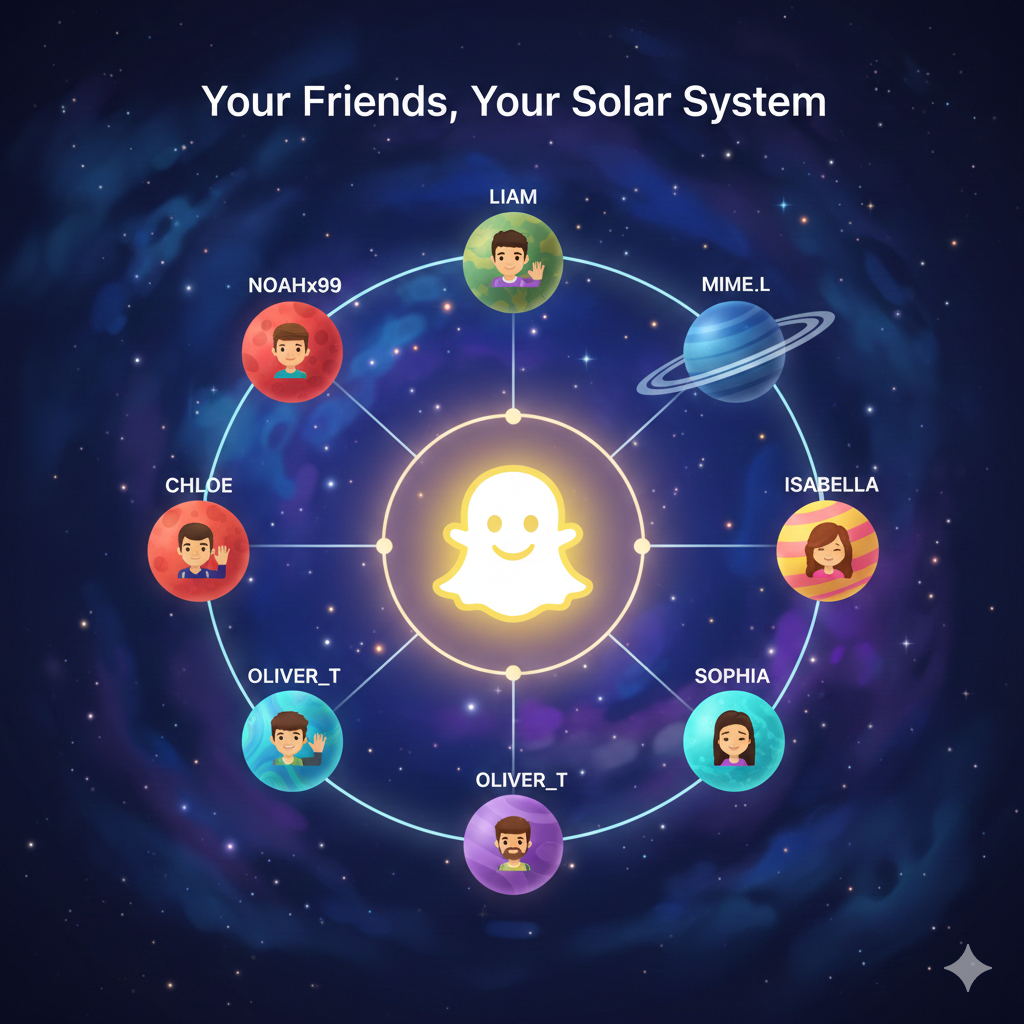
Snapchat Solar System is a visual ranking system on Snapchat’s friends page. It is an optional Snapchat Plus feature. It uses the metaphor of the solar system to show you how close you are to your friends on the app and how close they are to you. When you open someone’s friendship profile, you may notice a planet badge next to their name. It is a badge of Mercury, Venus, or Saturn. This badge is not an arbitrary decision. You are placed as a planet orbiting its sun, and that is its profile. It represents your rank on their friendship list based on your activity.
It is a social astronomy lesson. The friend solar system gives a unique view and access to a hidden metric of social distance. It provides a simplified, tangible means to measure social investment and relational strength. It makes a very abstract concept of being someone’s best friend a lot less abstract.
3. How the Solar System Feature Functions: The Astronomical Mechanics
How, then, does Snapchat’s algorithm determine who gets the title of Mercury and who gets the title of Pluto (which, by the way, has a whole other metaphor attached, since Pluto is not included)? This digital solar system runs on the mechanics of mutual interaction data. The engine that powers this system is the macros of your chat frequency.
Snapping and chatting: the more you and your friend exchange Snaps and Chats, the stronger your gravitational pull.
Story views and engagements: consistently viewing and reacting to each other’s stories also fuels the algorithm.
Reciprocal, but asymmetric: the placement of your planet in their solar system is also calculated independently from their placement in yours, and vice versa. You may be someone’s Venus (second closest) while they are your Jupiter (fifth closest). This asymmetry is where much of the social intrigue and even social anxiety comes from.
The orbits and positions of the planets in this system can shift and change based on the ebb and flow of your virtual socializing. It is all based on your ‘digital friendship’s heat’ and is fully automated.
The Snap Solar System planets. From Mercury to Neptune.
To understand the Snap Solar System, you need to know your planets. The Solar System in Snapchat is structured as follows (from the innermost and hottest to the furthest and coldest orbit):
Mercury: Best friend #1. The closest planet to their sun. This means you have breached the vault of maximum, non-optional interactions in the app.
Venus: Also a very close 2nd and still in the prized ‘inner circle’ of friendship.
Earth: The third closest planet. Position of stability as a result of strong and continued contact.
Mars: your friend number 4. Also in the close friend zone and of significant orbit.
Jupiter: The 5th planet and a major one, but just one of many in its social orbit.
Saturn: The next, 6th.
Uranus: Position number 7
Neptune: The eighth and farthest recognized in this planet-system of orbits dedicated to your friends.
Important to restate: there is no Pluto. The 8-friend limit creates a distinct inner solar system of your top friends.
5. Understanding Your Place in a Friend’s Solar System
The Snapchat planet feature is powerful. If someone has you as their “Earth” planet, you matter to them. If you consider someone to be a “Neptune” in relation to your “Mercury” planet, it might be a rude awakening.
The Snapchat friendship hierarchy shows you how close you are to someone and how you each rank the friendship. Snapchat is likely trying to socialise currency through the planetary badges some users may chase to increase their social status as a “Mercury” in someone’s friendship. The planet badge a user has can drive significant behavioral shifts, as part of the pseudo-friendship hierarchy game.
6. Explanation of Planet System
People are wondering why the Snapchat Solar System is a big deal. And the answer is that it plays into the human urge for social rank and belonging to a group.
When you can quantify and measure a social friendship, as you can with Snapchat systems, it provides social dopamine. Achieving a higher social rank in card games with abstract social systems becomes a game that drives engagement and keeps people on the social platform.
Digital and Visual Confirmation: In a world driven by digital and invisible relationships, a planet badge becomes a visual token of a relationship’s importance. It is a social media badge of honor for a solar system.
Answering Curiosity-related Questions: “Where do I stand with this person?” This question is almost always present, and the snap friend ranking answers it, albeit in potentially harmful ways.
The Emotional Gravity of Orbits: It is not just about stargazing and wonder. A solid source of “orbit anxiety” is introduced through this solar system. The pressure to maintain a planetary position is burdensome, turning friendships into something transactional, where users feel obligated to snap “keep their rank.”
The imbalance in the solar system is also a common frustration. “Why am I their Saturn, while they’re my Venus?” This could stem from overthinking, insecurity, and confrontations. Relationships are quantified in potentially toxic ways, with the system answering the question ‘how much do I care about this person?’ in a misguided way. The system is not an accurate reflection of a friendship, just a measure of Snap interactions.
8. Case Study: A Real Life ‘Solar System’ Shake-Up
Let’s take the example of Maya and Leah- two friends who were a year apart in college. Before the feature, they used to snap each other every day. When the solar system features launched, they were each other’s Mercury. It was finals week, and Leah was stressed and, therefore, snapped a lot less. Maya noticed and, in a very short time, became Leah’s Venus, then Earth. Maya felt some way, so in a panic, snapped at Leah more. Leah felt a mix of smothered and guilty. A simple system algorithm caused all of this tension.
That is what this example illustrates: the emotional consequences of the planet system in a snap. Unlike a m#### # and c # ####, Leah and Maya were able to step out of the planet system and realize it was a distortion of a simple off-platform communication. They eventually used the function to satisfy their curiosity, not as an actual scorecard.
9. Managing Your Cosmic Connections: Pro Tips and Privacy
If you feel a weighted pull of the solar system feature, you have options.
Keep Your Head Up In Case of Context: A planet’s placement in its solar system is a measure of its activity in a snap, NOT about the quality of the relationship. A friend who is a Neptune in the snap solar system could be a daily call friend, but is your rock in reality.
Use Mute Then Unmute: If watching orbits shift is stressful to you, you can mute a friend’s planetary badges or even mute notifications for that friend’s ranking system.
Turn It Off: The nuclear option. You can completely turn off the Snapchat Solar System feature in your Snapchat+ + settings. You will stop seeing your planets and stop appearing in other systems.
Don’t Game the System: Trying to inflate your rank with a bunch of low-effort snaps artificially feels inauthentic and backfires. Let the interactions flow naturally.
10. Beyond the Feature: The Bigger Picture of Social Ranking
The Snapchat Solar System is the latest in a long chain of social systems rankings. From Myspace Top 8 to Instagram Close Friends, we have always sought to categorize and rank people. This feature, however, makes the ranking more automated and dynamic with a fun metaphor. It speaks to the moment where we expect sophisticated algorithms to define and arrange our personal relationships.
As we adopt these social solar system tools, we have to ask: do they improve our relationships, or do they turn friendships into a performance for an algorithm? The Snapchat friend solar system is a fascinating, if sometimes distorting, mirror to the friendships we have in real life.
Conclusion: Noting Your Place in the Digital Universe
The solar system in Snapchat is one of the more interesting features it offers. It combines childlike creativity with a high-level understanding of social dynamics. As with almost any social interaction, this Snapchat solar system can elicit a range of positive and negative emotional responses. Regardless of the reaction, this feature has had a social impact. It largely changed the way Snapchat’s tradition of friend ranking is perceived.
As you traverse through your very own digital solar system, the planetary positions should be taken with a very small amount of stardust, and the Snapchat Solar System should be more of a loosely followed guide instead of a steadfast belief system. The connections made in real life will be the ones that truly spiral, and those connections will be the ones that truly illuminate the digital wormhole you exist in.
You may also read routertool.